Over unity in Copper
Preface:
A device that appears to produce more output energy than goes into it can be loosely called an over unity device.
However we know that energy does not come from no where. There is much
speculation as to where this energy might come from, and many theories
have been written now at the beginning of the 21st century, but to date
no one is freely sharing a working device with the world. The purpose
of this document is to show that this is very possible,
and from what we already know today. One need only give up the
notion that Copper atoms run on energy from the big bang winding down,
and adopt a more rational concept that they are actually
powered moment to moment from a light speed spin existing within
them that produces continual mass momentum of the nucleus which is self
regulating and self recovering back to a near light speed constant. A redirection of this internal force can set the stage to capture the internal energy.
In 1997 a device surfaced claimed to have been created by Steven
Mark that was shown to produce some 1 Kw of power containing little
more than Copper windings embedded in cork and plastic and some
"secret" pulsing circuitry. The device was sealed, suposedly due to
financial reasons.Once started up this device was self powering. One
more example to be added to Floyd Sweet and Hubbard that appears to be
over unity with respect to our physical world.
Theoretical:
Looking closely at NMR [nuclear magnetic resonance]
it becomes apparent that devices that pulse copper coils can
be set up to produce more electric
output than is put into them to
cause the output that it should based on the simple turns ratio
formulas, using 90 degree positioned coils. While this apears exciting
on the surface we must realize there is a difference between the
presence of voltage, and power, which is also a function of the current flowing. To cause an output from Copper wire which is driven,
not entirely by the input pulse, but by the input pulse plus the atoms
natural self regulating negative response to the input pulse and its normal mass rotation, seems to
be the method. This can be though of as redirection of the atoms natural nuclear force. Wilbert Smith also spoke of reversed precession, found in Otis Carrs saga as forced precession.
These are mass and motion manipulations, and when we compare the
interaction of voltage and current in Copper we see the tempic field
split the electric and magnetic forces into a leading and lagging
situation. Normally this will not create an OU situation. The feeling
of most studying the OU devices we have had access to, believe there is
a condition possible that will in fact do this. The factor that is not
being considered in the normal EM technology is the mass of rotation at the nucleus, and its natural precession motion.
If this motion can be altered to lower the atoms negative responses
than a tempic field acceleration may be possible. Copper has a magnetic
hook at the nucleus allowing mass rotational effects to be manipulated.
We have been finding this normally around 1 to 2 Mhz in many of the
coil devices we are experimenting with. The actual frequency is a
function of the magnetic field intensity, so with AC this is in a state
of constant change and may follow the normal EM resonance of coils.
Density sphere:
[Square wave transmittion]
It is not normally expected that a square wave can propagate a
transformer because copper is seen conventionally to react only to a
changing current.
In normal EM interactions, as we hit the electron shell with a
flowing electric current, the Protons magnetic field will turn to align
with it one of two ways, but it will always follow the magnetic poles
bringing spin of mass along with it. The Proton will turn slower,
however it carries the mass of the atom with it so the tempic field
effect is a dragging of the current generated back out by the effect.
This will cause the current to lag the voltage as the mass spins up,
dragging the electron flow on the surface of the electron shell. The
interaction resists the change of current
and not its static state. Conventional EM electronics believes this is
strictly an electron shell effect but will agree that the current will
in fact lag the voltage in copper coils and this is a "real time" or
tempic field effect. What they miss is that the effect is also a
geometricly spherical effect and 90 degree coils can show this, they do not normally identify this with the coppers mass.
In the 90 degree coil set ups we see extremely high voltage spikes as
the voltage is turned 90 degrees faster than the Proton can turn the
mass of the nucleus.
As we turn the magnetic field by 90 degrees, there is a reverse current surge along the original spin plane and a voltage surge
along the new spin plane at 90 degrees. The two sit in spinning
opposition to one another because one is the back EM and one is the
forward EM. We have now seperated the forwards Electron spin from the
dragging Proton spin for a measure of real time at the NMR rate
angularly. If we place two sets of coils on a density sphere at 90
degrees, pulse two at 90 degrees in series, then extract from two
more in "series reversing" we get back out the original wave by
capturing both spin planes and combining the current surge back into the voltage surge as aiding pulses rather than countering ones. The coil config will pass a square wave through it keeping the sides very sharp
as it captures both surges. This is quite an accomplishment for a
copper transformer. Passing a true square wave.We have captured both
halves of this from both spin planes at 90 degrees and recombined them
by reversing the phase. It is also possible to put an AC voltage into
one scalar coil set and get the original wave back out by using the
other two coils at 90 degrees to the primary. With these configurations
we see actual power moving
through a scalar cancelling coil and having enough current to carry a
load. This is in direct violation to current teachings for EM as to
cancelled magnetic fields.
Under normal circumstances the density sphere can give nearly a 1 to 1
power throughput on this and carry a load with a square wave moving
through it. Very strange to see a scalar cancelling coil transmitting
power to a load. Also very strange to see a square wave moving through
a transformer, with flat tops to the wave forms, which are not thought
to be a change of current, but when broken down at two angles in fact are.
In a system with one coil wrapped at 90 degrees over a larger inner coil to form a donut the following wave forms are observed. The system is pulsed with square waves of almost any frequency below 5 MHz.
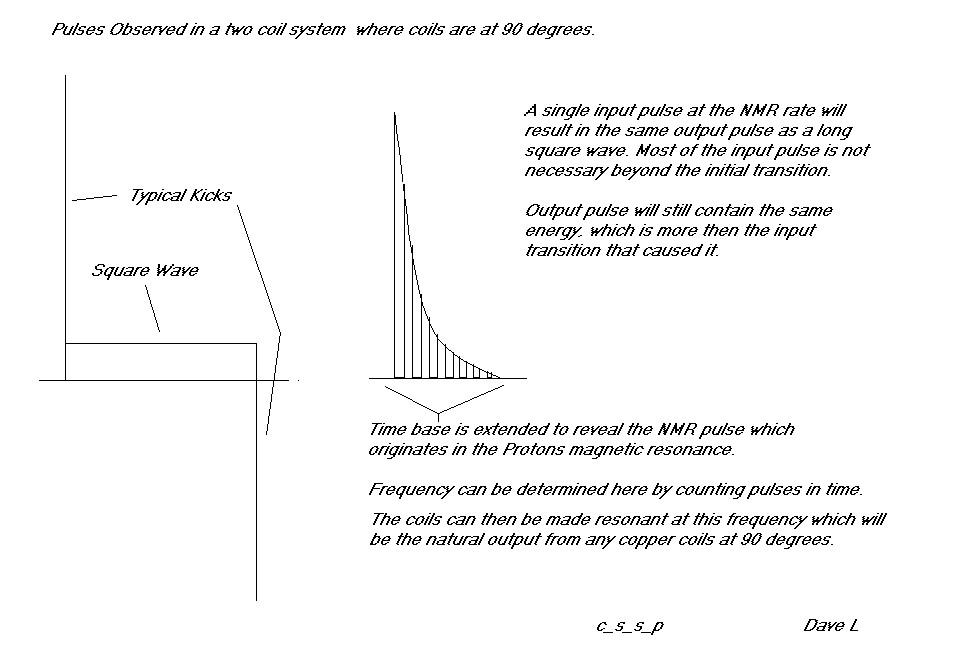
Shown on the left, the length of the square wave input pulse for
the donut setup was altered to see what change it had on output and
discovered that there only need be one pulse of around 5 MHz to produce
the full output signature observed on the right above. NMR teaches that
a 1/4 wave pulse is all that is necessary to set the mass of the copper atoms nucleus into motion. If one now adds these output
pulses up coming back out of the 90 degree coil they discover it apears to have more energy
over time than the single pulse starting the process. The output energy is
directly related to the mass of the Copper under transition as it continues to move after the initial pulse is gone, and larger
more massive coils produce more power output on this trailing ringing wave. Small coils produce
unstable pulses and touching them can disturb these, but more massive
coils produce strong pulses immune to external capacitive effects that
become very stable. A single loop coil 6 inches wrapped with #10 wire,
surrounded by 5 more #10 Copper rings produces strong pulses that are
immune to touching.
The scope is showing the voltage surges, as the electron shell is
released from the normal drag when the protons spin is aligned with it.
The two forces are countering one another. We see the energy comming
out along a different angular axis as the two shells are not in alignment.
The key to power extraction may be related to how the atoms of Copper
recover, and it has been observed that the back EMF pulses are often
more powerful than the electronics that generate them, often even
burning out the driver transistors. While this process may seem
rather random, it is not random but related to the NMR rates and when
the pulses coincide. You may well pulse up a device many times and only
on one out of 100 times the back EMF pulse will fry a transistor.This
is probably due to NMR pulses stacking between the coils interactions.
This is increased by adding copper to the core of the coils, or a
combination of copper wrapped over iron. If done synchronously at the
NMR rate I would expect we could learn to fry them every single time.
We only need have two of the highest pulses hit at the same moment in
time to double its amplitude.
Secondly it was amazingly discovered that even scalar wound coils still
produce the NMR pulse just before the energy moves out of the EM layer.
These kicks are ever present in scalar wound input coils as well as 90
degree coils wrapped around them.
It has been pointed out that using pulses at 90 degrees to one another
does not create a true rotating magnetic field, however one must
realize that at the Proton layer, the torsion is in fact in mass rotation.
The rotation however is a spiral rotation and it is driven by the mass of the copper that
is in rotation. While a pulse of EM through the Copper moves along its
Electron shell, the spiraling rotation at the Proton shell is very
real, and the tempic field is set now into a smooth sine wave spiraling
motion containing a constant energy not totally related to the energy it took to start this redirection of its normal motion, but to its mass.
On the Steven Marks Device:
Observing the rotation of a magnetic field through a Copper wire, where
the field moves, not in the normal method of electric motors but
between two coils at 90 degrees to one another in the donut pattern.
Magnetic field rotates along the Electron shell, and tempic field
swings along the Protons shell which is directly connected to its mass
, a distance linear force. This process is an inertial momentum
at the Proton layer but becomes EM as it hits the Electron shell
once again coming outwards in Copper. This results in a magnetic
rotation as well that can be measured with a compass at low frequencies.
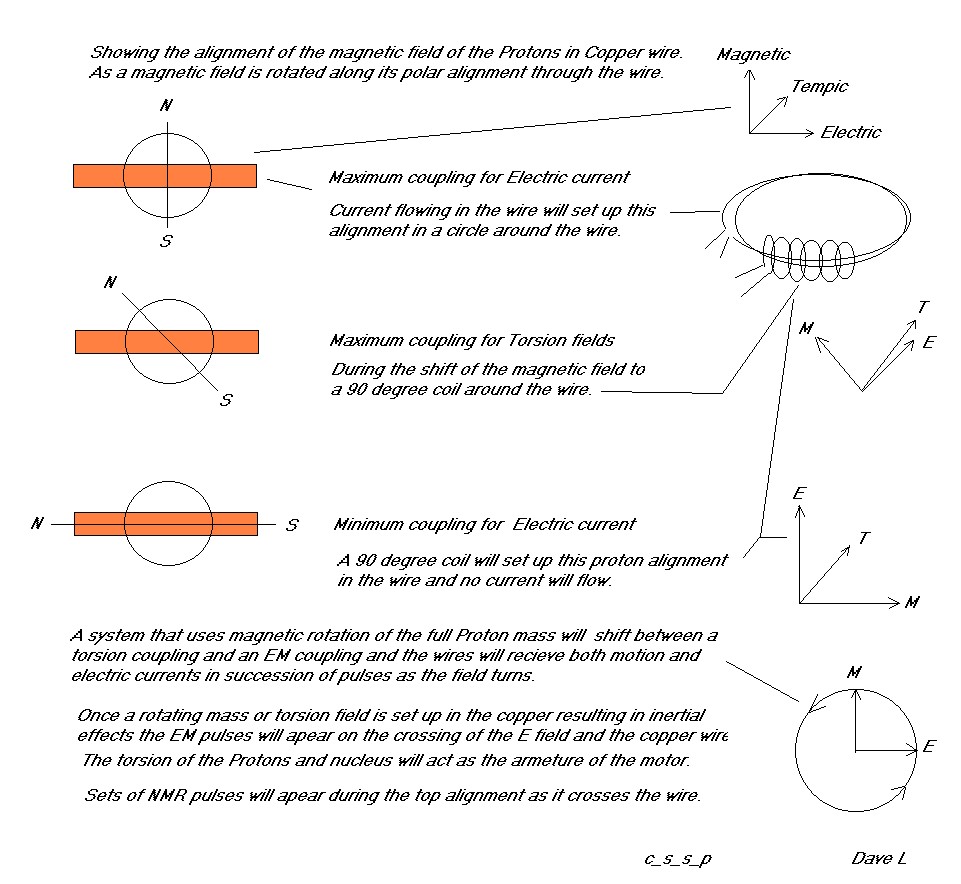
The one main advantage to using Copper is that it is the one element
that will propagate both EM and Torsion fields through its length. The
torsion flows most freely when setting at 45 degrees to the magnetic
field, so as the field swings between each 90 degree angle there will
be a spurt of torsion through the wire as it crosses 45 degrees. This
will cause a physical vibration or a motional effect. As the magnetic
field crosses 90 degrees to a wire we get the NMR pulse train an EM
effect.
If it were possible to wind many coils at various angles to the input
coil, one every few degrees, we would see an almost constant
output of pulses in time as the field swings only 90 degrees back and
forth between two pulsing coils.
360 degree rotation
If we can master rotation of the Copper nucleus in the correct spin
direction, with the correct pulsing configuration, it may be possible
to achieve a 360 degree spiral rotation which begins to counter natural
precession, and constantly outputting more energy than it take to
achieve this rotation. Observing lasigous patterns on an O-scope is an
example of this in two dimensions. We must master a three dimensional
one however to achieve a complete mass rotation and turn our Copper
nucleus mass into a motor armature. If the recovery system of the atoms
mass now moves into a closed repeating loop then energy can be
extracted from the recovery energy that should far exceed energy to
start the process. This is based on the observation that Copper atoms
will always recover no matter the load we place on them, they always
push back with stronger force.
An EM Density sphere:
A density sphere created on a solid or a hollow Copper sphere would be expected to attain a coherent torsion field
through out, and thus using coils wrapped around it at various angles
would provide start up energy as well as tapping energy. Output coils
must be separate from input coils, and coils can all be driven with the
natural outputs from other NMR resonant donut coils producing the correct frequencies of NMR pulses or very close to it.
In this special case of a density sphere, we are moving not only
torsion fields but Electron fields into interaction.
Voltage follows the Electron shell and current follows the Protons
turns angularly. EM resonant coils can be placed at 45 degrees to
torsion resonant coils
if both interactions are desired to study.
Output is a direct function of Copper mass in rotation along the tempic
field. Since the tempic field effects density and gravity as well, this
spherical device will emulate a single copper atom along the torsion
field, and a single coherent magnet along the Electron shell when
Electrons are flowing.
This is the first motor suggested that contains a 3 dimensional armature composed of the mass of all the Copper present in the sphere. The sphere is a Copper only device.
It is believed that using a sphere will allow these principles of mass
rotation to be accurately studied and documented. Three large and
separate donut coils can be used to drive the system tied to three
or more driver coils on the sphere at various angles. In this way
independent or non coherent Copper driver coils can be used to pulse
the sphere into mass rotation rather than an enormous system of pulsing
circuits. Feedback can be via electric or tempic field depending on the
coils positioning. 90 degree coils in series can rebuild tempic
fields at 5 Mhz external to the device to provide feedback from a 45
degree coil, or 5 Mhz resonant EM coils can be used.
Control requires only three pulsing transistors that can vary frequency
and phase.These are run into three separate donut coils and output will
be NMR resonant pulses based on the mass of the donuts. To totally
eliminate the possibility of frying the transistors the primary side of
the donuts can be wound with scalar coils, this will eliminate any
possible back EMF. The output side will be normal wound coils, 5 MHz
resonant, and feed the next coil series.
Reversed precession:
If a density sphere is driven with DC pulses along the three planes of
motion, the magnetic field will move into a precession motion. The
North pole of the coils will move in a basic triangle without flipping
over. Protons spinning mass will lag this turn. If the direction of
rotation is reverse of the Protons mass spin this may lower inductive
drag and accelerate the atoms energy state. It is very probably this
sort of manipulation at the NMR rates that may lead to some intresting
effects in Copper offering more energy out than goes in.
Density sphere as a transformer:
With correct configuration of four coils on the surface of a
density sphere we can create a transformer that will pass square waves
as well as power a load.
With four coils in another configuration we can power a load using a
scalar coil primary in only one spin plane and capturing voltage and
current from the other two spin planes as it swings between them. This
uses all three spin planes. As the scalar coil is powered with AC the
voltage and current alternate between the 90 degree coils and can be
recombined in the correct phases to add rather than counter.
This shows the mechanism of scalar cancelling coils and how the actual
energy present is not lost, but moves into the inertial momentum of the
particle spin motions, and then back out. It also shows how the
elements of electronics are actually split between the two shells in
operation. The electron being lighter and faster carrying the voltage
aspect, and the Proton being slower but more massive carrying the
current aspect of the force, in copper. The interaction between the two
carrying the power, which is the product of both normally countering
spin forces.
Dave L
c_s_s_p group
4 - 4 - 2007
Home Back to Thoery