Over Unity in the Flywheel
It would seem that mankind has already found two methods of gaining Over unity energy in orbital systems.
In the one case we have a sling shot orbital maneuver, the second
in the mass of a rotating wheel being pulsed under powered acceleration.
This sheds much light on both the Searl disc and the Utron
as both use pulsing magnetic drag to generate over unity. Searl disc has
a system of 12 minimum angles of the wheel using opposing magnets, and
the Utron uses a magnetic pulse against an inductive metal on a fast
spinning wheel or conical wheel.
The following are a few of my own thoughts on why this may happen.
Centrepital and Centrifugal forces in a spinning wheel
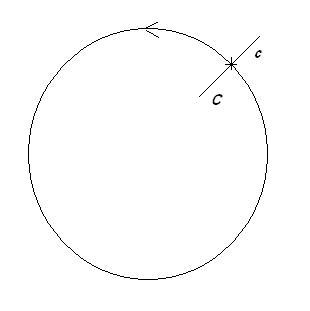
When we look at a spinning wheel we find present a scalar canceling pair of forces in balance. Centrifugal force [C] is acting strongest on the nuclear mass where the weight is the largest factor of the atoms. Centrepital force [c] is pulling inwards and due to the stress held in the electron shells of the atoms of the wheel, binding the weight towards the center and fully resisting the outwards thrust of the Nuclear mass.
These are not fully locked together but there is in fact a motional
interaction between them at the nuclear level. The two countering
forces are bound in different parts of the atoms structure.
Thus in the case of an impulse alteration
of forwards or reverse momentum of the wheel, both forces may be seen
as separate and thus treated separately during vector addition, and then
summed. This is of coarse more true for a faster pulse timing due to
the short distances inside atoms.
We must first recognize that in a "sling shot" or a rock twirling
system, if we put a small amount of accelerating energy into the final
turn, the rock gains over unity energy. Similarly if we place drag here
the rock will nearly stop. The sling shot orbital maneuver relies on
acceleration being placed on the system at 90 degrees to the countering
balanced forces. Setting these two forces off balance we discover that
each force in itself will add energy to the velocity of the rock. While
they are not being deflected they are fully canceling, but since they
both operate in reverse, as they are set off centered, the vector
result is that both will effect the velocity the same direction.
Alternate energy research teaches us to observe that when opposing forces meet they do not cancel. Even
though a net zero energy may be present, both forces are still very
much present. You cannot just add them together get zero and then
forget about them for the offset force interaction. Thus a 90 degree force
redirecting both will be shifting this higher energy off centered on
two sides of the balance, and now each side must be observed before
summing the result.
Vector addition
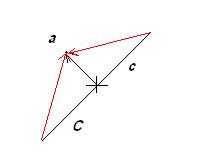
Resulting force is the sum of all the vectors of acceleration present.
The red lines are after the first step of this process where we add
each opposing force one at a time to the offset force at 90 degrees to find the resultant equivalent vector of energy.
This means that the resulting offset force will be the sum of both
resulting forces. If the two are equal then there is a doubling of the
deflected energy. The vector tangent to the wheel must have its length
doubled. As long as this vector model is true, the circle will be in an
over unity state, drawing energy from the time domain [higher density compression area]
and placing it into the motional vector of the wheel.
Atoms
Bringing energy up out of the nuclear mass is the description for the
Hamel cones, if the nuclear vibrations can be coaxed outwards we get
additional energy from the atoms internal spin momentum.
It has been surmised that as the wheel spins over time the nucleus of
the atom will slowly come into alignment with this spin, and begin to
store it, as well as align some of its own natural spin momentum with
the new angular momentum of the wheel.
A compressing force causes the nucleus of the atoms to be pushed
against the electron shell and alters the c velocity of angular
momentum
inside the atoms. Between these two shells all is EM and nuclear mass
is floating, yet the major weight of an atom is at the nucleus and not
the electron shell. As we add
acceleration to the wheel this angle of highest compression between the
atomic shells is altered tilting the vectors of force accordingly.
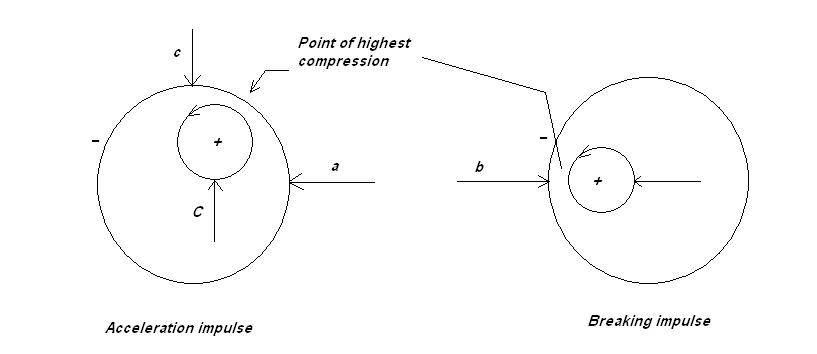
The above chart shows at the circumference of
the wheel, the compression forces between Electron shells
and nuclear mass change there alignment. As the nucleus rolls forwards
its pressure against the electron shell may impart additional spin from
the nucleus of the atom to the outer bonding structure of the wheel.
The area of highest compression tilts its vector angle from C alignment
towards wheel motion and imparts energy between these three vectors.
Energy from C stored in the nuclear mass is imparted against b and
finally deflects c accordingly.
The resultant of these two is actually about a 45 outwards, as the
second diagram shows a full 90 degree force which it would only reach
if coming to a complete stop and C disappeared. The nuclear mass will
rock back and forth front to back as the wheel is pulsed somewhere
between probably about 45 degrees either way. As we have seen
previously the 45 degree angle is torsions natural path for sensing
torsion fields. Just how the nucleus will impart additional
energy to the wheel is obviously not clear at this time.
Irregardless of the reason for the energy gain from pulsing a wheels
forwards momentum under power it has been shown to create OU. This is
no small discovery!
In a wheel the important functions are mass of the wheel [ mostly along
its outer circumference], wheel velocity, and acceleration of the wheel or pulsing power.
The wheel must be pulsed under power to give the energy gain, just
as a sling shot on the last turn before release, now a sharp release
for an instant or a reverse impulse, the compression angle between
nuclear mass and electron structure will shift radically over the top
and forwards crashing into the electron shell in the direction
of motion of the wheel.
Concepts gained from this study:
1 - A spinning flywheel
can offer OU energy if pulsed. The loop can be closed from motor to generator!
2 - The energy
comes from the nuclear mass and off balancing of the forces comparable to gravity
and Centrepital, for
a sling shot orbit. In the case of a wheel however
gravity may not be the main source of the energy but opposing or
scalar
canceling forces of centrifugal and Centrepital forces deflected. This system should work
where there is no gravity or
also if the wheel is running horizontal to
gravity although possibly not as well.
3 - Pulsing would best not drop
below forwards power draw. If driving torque is dropped completely, then the
vectors
may reverse and loose energy rather then draw it from the time
domain. The best setup may not be a pulsing
drive motor, but two
motors set in conflict. The first motor provides a constant forwards drive, the
second motor
pulses in reverse with very short duty cycle pulses not
strong enough to fully counter the first motor so the
forwards vector
never drops away. The two forces meet on the flywheel shaft.
4- The drive motor must always be accelerating the
wheel so never fully comes up to the full speed it could impart if
allowed to run free.
5- Opposing magnets set up correctly around the
circumference could offer both sharp pulse drag, and higher
opposing
force to increase the output of the system. Duty cycle on this ring would
become the control. Shift
the dragging past 50 percent and we gain
control of the wheel backing it off. This can be done with
electromagnets, or a weak pulsed motor in opposition.
6- RPM needs to exceed gravity probably, and C may be well over 32 feet
per second squared at the outer circumference of the flywheel, other
wise nuclear mass will remain restricted to the lower areas of the
atoms.
7 - Pulse rate should be as high as possible. Setting up oscillations
in the flywheels velocity can become quite invisible to an observer at
OU speeds.
This information
should be useful to any flywheel system seeking more out then goes in.
References
Documentation on Chas Campbells Flywheel device Patrick Kelly
Studies on Physical wheels and acceleration David Lowrance
Overunity.com studies Chas Campbells flywheels
"Tsing Hua University in China worked with an old Chinese Inventor and had a
video taken on January 4, 1996. That invention could magnify Input Electricity
30 times and had been used in a factory environment for over 11 years."
Home