Experiment 8
[Studies in Diamagnetism]

Feeling the Electron Spin Cone of a magnet
David Hamel talks of the isotope line falling into stacks of oppositely spinning magnetic nucleon's in Aluminum.
I have discovered a way that I can sense this line in neo magnets. As the hands are diamagnetic they are the perfect tools for detecting strong vibrating magnetic fields. A
normal coil wrapped around a magnet and stimulated with low voltage low
frequency energy brings the magnetic field to life with the sensation
of heat from the Electron Layer. This is ESR modulation. Since all the
atoms in a magnet are aligned N/S and more are aligned one direction
then the other direction it stands to reason that a dominant torsion
force would be present in the field. By causing the spin field to
vibrate slightly, opening and closing the cone of motion one can
sense the cone of torsion present around the ends of the magnet.
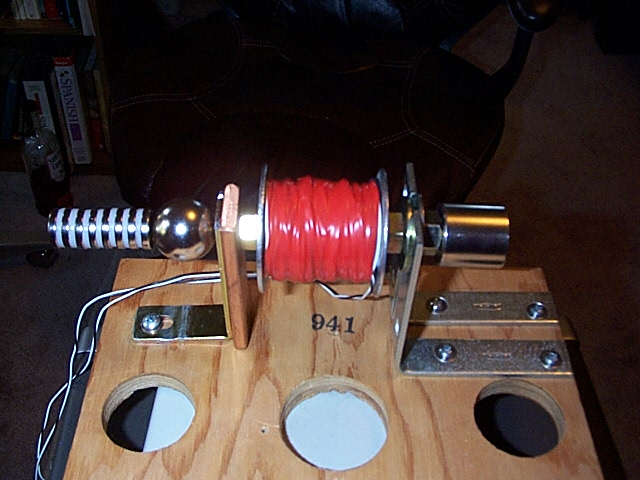
This device was constructed in an attempt to discover how to generate a
large Diamagnetic field. Notice the copper bar placed between the left
magnet stack and the coil. During experiment the heat sensations were discovered and mapping the cone commenced, to discover the ESR tilt angles of the magnet. On touching the device no actual heat is being produced anywhere.
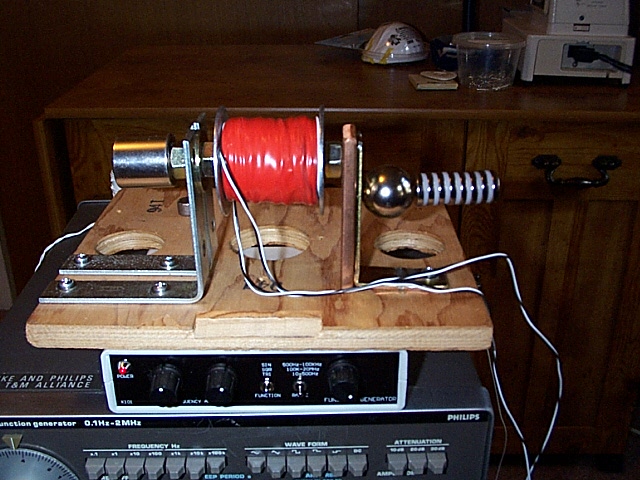
It was discovered through feeling the heat sensation in the vibrating
field that a stronger flux interaction with the copper resulted from
offsetting the two magnetic fields to align with the cone of vibration
as it crosses between them. Somewhere between 10 and 13 Mhz the copper
began to feel electric and a small physical vibration was felt to
emerge. 800 mv dc appears across the copper bar side to side during this vibration.
Although this could be RF radiating along the polar face of the coil,
that seems pretty high for a standing voltage on a copper bar,
considered to be a dead short in all our modern Electronics models.
Also considering the wavelength of a 13 Mhz RF would be several meters,
RF resonance is not likely, and the coil is only being driven by a 2
volt signal. This may shed light on the Searl disc alignment of
rotating
spokes that turn through one another found in the Roshin and Godin
device.
Principle of the Diamagnetic Field generator

This design is based on the Searl disc which may be accelerating based
on the diamagnetic regenerative effect from a time lag between when
torsion is applied to a magnetic field moving through copper, and the diamagnetic field
resulting from the torsion. It was hoped that by applying AC to the
control coil that an inductive kick back would be produced larger then
the energy needed to produce a 90 degree turn of the copper Protons
field, aligned between two magnets at 90 degrees to one another. The
bias magnets are critical to getting the opposing magnetic wall
centered near the copper bar.
For this principle to work the opposing North poles must meet inside
the thin copper bar. The coils then push the center of the opposing
flux to one side rotating the field 90 degrees in the copper and
placing torque on the Proton field. The resulting torque on the Proton
field should produce a large diamagnetic field sending an inductive
kick back into the output coil.

In this balanced design it is much easier to control the tripole center
where flux lines bend the sharpest away from opposing or "bucking"
fields. At the center between the coils the flux lines take a sharp
turn to 90 degrees up and down. By feeding the coils 180 degrees out of
phase to shift this center point we can shift the flux angle in the
copper by 90 degrees which should produce a strong diamagnetic field
during the motion of the shift.

By using the angled cone alignment the interaction with the copper bar
seems to become stronger. The magnets are opposing and the opposite
cones sides [torsion] roll along one another in this config. I believe
that this results in a rolling of the Protons field that manifests as a
small vibration around 13Mhz as well as a larger sensory
vibration around the interaction.
If in fact the diamagnetic field has an over unity effect possible I
believe it is these kind of devices that may allow us to discover it.
Although the fields I am using here are very small, they have shown
some surprises. To get an inductive kickback from the copper bar will
require either much stronger coils with higher voltages and heavier
wire, or actually spinning copper cylinders with opposing magnets past
one another such that both surfaces move the same direction, as in the
Searl disc.
c_s_s_p
Home