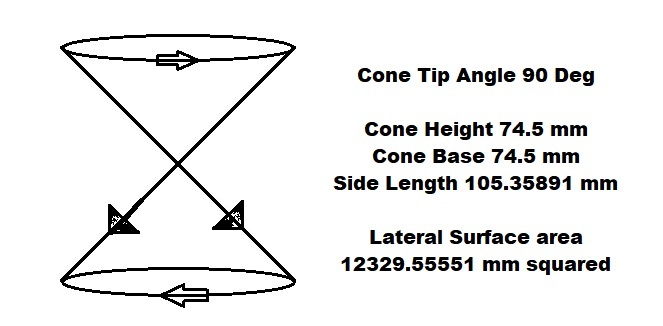
Gravity Cones
2026 - 2 - 26 David Lowrance
How Does Gravity Work
The active force of the
acceleration vectors are at 45 degrees. The power comes from the
lateral surface area of the Isotope mixed cone system.
This is a Fibonacci sum of all the Isotope frequencies of the
table of elements present in the Earth, thus it has a 12x octave system
and can be expanded as a Fractal system.
Set your calipers to 105.36 mm and hold it at 45 degrees off the vertical and run your finger down inside to note the high density of the field that comes up.
It is the same density at every point along that line.
This is Gravity.
The vertical vector resonates at 74.5 mm but has no real power other then it can be used to pull up the geometric form in space.
The Gravity power only resonates up at 45 degrees, as you tilt the calipers you should feel it only very near that angle.
Manipulation
The cones can be manipulated in the same way we manipulate individual isotopes using the conical spreadsheets.
We can alter the angle of the tip, we can invert them with the 72 degree modification setting the wide ends together
and we can perform other transforms on the lateral surface area that is the powering surface, same as isotopes.
From this understanding of where the power is located however we can begin to experiment with gravity as it actually works.
This sheds light on Otis Carr's UTRON system as well and why
he uses the perfect 45 degree spinning cones to unbalance the Gravity
inertial component.
Otis Carr uses the spin on spin technique developed by Tesla
to create an unbalanced centrifugal force pulling upwards at 45 degrees.
When the small cones spin in the same direction as the larger
disc, the inner side almost stops moving, and the outer side is moving
2 times the velocity of the larger disc.
This generates an inertial force opposite of the gravity vector at 45 degrees.
The Isotopes in the Stainless steel or the Aluminum of the
craft can then take on this angle as they respond directly to isotope
alignment mass vibration systems.
This coupling may also be frequency dependent for the
material used. Thus a mediator frequency may be necessary to couple to
the materials Isotope cone side length frequency.
Spinning up Aluminum cones may also produce high voltages as was shown in experiments.
We should also note that the Isotope angle of the cone tips changes in
Copper and Aluminum with the presence of a magnetic field passing
through them.
While the natural Isotope angle is 30 and 60 degrees, when we touch a
magnet on them the tip angles compress inwards to the same angle as the
Gravity cone wave.
This is why the magnet falls slowly down inside a Copper or Aluminum pipe.
The purpose of using magnets in the Graviflier is not to generate eddy
currents it is to manipulate the isotopes to couple directly with the
Gravity fractal alignment.
Summary
The power of gravity is thus a zigzagging force as David Hamel diagrammed.
The fractals however are extremely small, we have magnified
them with fractal expansion techniques for measurement purposes so
they can be measured and tested.